Resources

MediaCare in plain words for families, how to take part in the research, plus news and open-access papers.

For families

MediaCare in plain words: what it is, who it is for, and what taking part would mean for you.

What is MediaCare?

MediaCare is a research project at the University of Florence. We are creating an app to help parents and carers find information they can trust online, and spot information that may be wrong.

Who is it for?

Parents and legal guardians of children with autism or ADHD. You do not need any special skills: the app is being designed for families of all backgrounds and levels of experience with technology.

What would taking part involve?

It depends on the study. You might talk with a researcher about how you look for information, or try the app and tell us what you think. Before you decide, you will get an information sheet that explains exactly what is involved.

Do I have to take part?

No. Taking part is always your choice, and you can ask us questions before you decide. Every MediaCare study is checked by an ethics committee before anyone is invited.

Is my information safe?

Yes. Your personal information is protected under EU data protection law (GDPR). We only publish results that cannot be traced back to you.

How can I find out more?

Email eva.bei@unifi.it. When a study opens, the link to join will appear just below.

The MediaCare app

Would you like to take part in MediaCare research?

Recruitment has not opened yet. The link to join will appear here. Participation is always voluntary, and all MediaCare studies undergo ethical review before anyone is recruited.

News

Study updates, events and short plain-language explainers, newest first.

  1. MediaCare at MLA4MedLit 2026: “Whose Literacy? Whose Rights?”
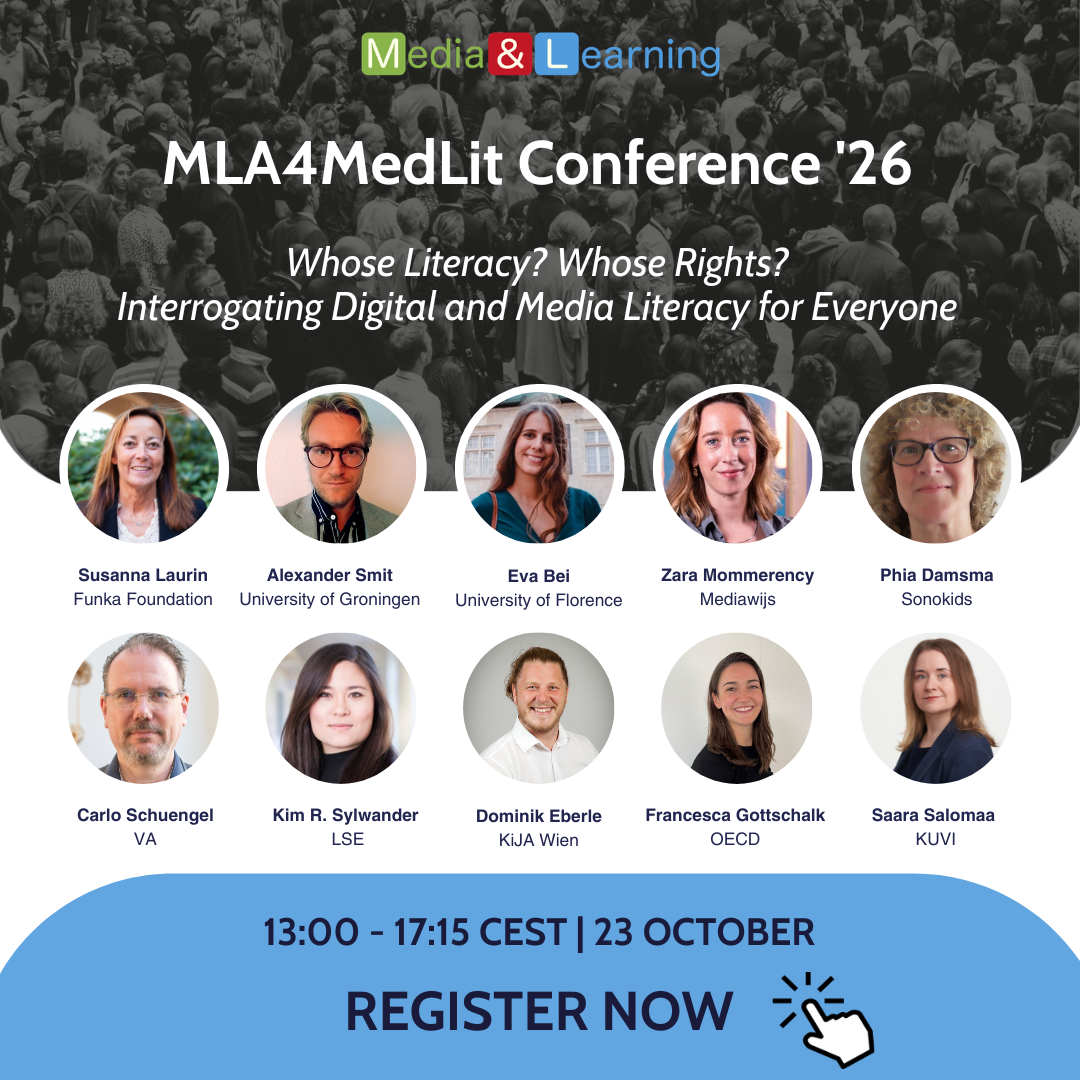
    Online conference, 13:00–17:15 CEST

    Poster for the MLA4MedLit Conference ’26 by Media & Learning: Whose Literacy? Whose Rights? Interrogating Digital and Media Literacy for Everyone. 13:00–17:15 CEST, 23 October. Speakers: Susanna Laurin (Funka Foundation), Alexander Smit (University of Groningen), Eva Bei (University of Florence), Zara Mommerency (Mediawijs), Phia Damsma (Sonokids), Carlo Schuengel (VA), Kim R. Sylwander (LSE), Dominik Eberle (KiJA Wien), Francesca Gottschalk (OECD) and Saara Salomaa (KUVI).

    Eva Bei spoke at MLA4MedLit 2026, the annual conference of the Media & Learning Association dedicated to digital and media literacy, this year titled “Whose Literacy? Whose Rights? Interrogating Digital and Media Literacy for Everyone”. She presented MediaCare, on misinformation among caregivers of children with neurodevelopmental conditions, in the case-study session “Whose Literacy, For Whom?” (14:00–15:30 CEST).

    See the full conference programme.

  2. MediaCare at BRIGHT-NIGHT, European Researchers’ Night, Florence

    Piazza SS. Annunziata, Florence

    MediaCare took part in BRIGHT-NIGHT 2026, the European Researchers’ Night (Notte europea delle ricercatrici e dei ricercatori), held in Piazza SS. Annunziata in Florence. Invited by the European and International Research Division of the University of Florence, Eva Bei presented the project and its outreach activities at the institutional stand showcasing Marie Skłodowska-Curie Postdoctoral Fellowships.

    For the occasion, the project prepared a short “Myth or science?” leaflet for visitors, with true-or-false statements about the brain and neurodevelopment. The European Researchers’ Night is a European Commission initiative funded under HORIZON-MSCA-2023-CITIZENS-01.

Publications

Open-access papers from MediaCare will be listed here as they are published, so that everyone can use what we learn.